


Holding Ethereum (ETH) is a common core position in a long-term crypto retirement portfolio — but simply holding it leaves yield on the table. Because Ethereum runs on Proof-of-Stake, ETH holders can help validate the network and earn rewards for doing so.
In a normal taxable brokerage or wallet, that creates a reporting headache: the IRS generally treats staking rewards as ordinary income the moment you gain control over them, which means a tax bill even if you never sell.
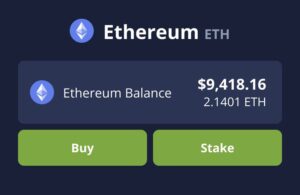 iTrustCapital staking Ethereum rewards work differently. Because the staking happens inside a self-directed Crypto IRA, rewards can grow tax-deferred in a Traditional IRA or potentially tax-free in a Roth IRA, instead of creating a taxable event every time they’re paid out.
This guide covers how iTrustCapital’s ETH staking actually works, current bonding/unbonding timelines, fees, the tax treatment by account type, the honest pros and cons, and a step-by-step walkthrough.
What Is iTrustCapital Ethereum Staking?
iTrustCapital offers native staking on select assets — currently ETH and SOL — inside both self-directed Crypto IRAs (Traditional, Roth, and SEP) and Premium Custody (non-IRA) accounts.
When you stake ETH through iTrustCapital, your holdings are deposited with a third-party staking infrastructure provider and institutional custodian rather than run through a validator you operate yourself. In exchange for helping secure the network, you earn protocol-level rewards, paid out in ETH once you unstake.
The appeal for retirement investors is specifically the wrapper: the staking mechanics are the same ones any ETH holder taps into, but doing it inside an IRA changes how (and when) those rewards are taxed.
How iTrustCapital Staking Ethereum Rewards Work
- You deposit ETH already held in your iTrustCapital account into the staking program from your dashboard — no external wallet, validator hardware, or 32 ETH minimum required, since you’re pooling with other clients through the provider’s infrastructure.
- Your ETH enters a bonding period before it starts earning. For Ethereum specifically, that bonding period runs around 42 days — much longer than most other stakable assets, and a network-level constraint rather than something iTrustCapital controls.
- Rewards accrue while your ETH is staked, based on validator performance and Ethereum network conditions.
- You choose when to unstake. Rewards are distributed at that point, not continuously streamed to your account — so there’s a real lag between “earning” and “receiving.”
- Unbonding for ETH takes roughly 1-2 days, but iTrustCapital states unstaked tokens and rewards can take 2-45 business days to actually land back in your account, depending on network and processing conditions.
🎁 Limited-Time Bonus: Sign up using our exclusive iTrustCapital link and fund your account with $1,000 or more to claim a $100 funding bonus deposited directly into your new IRA!
Bonding & Unbonding Times at a Glance
| Asset | Bonding (before earning starts) | Unbonding (after you unstake) | Time to receive funds |
|---|---|---|---|
| Ethereum (ETH) | ~42 days | ~1-2 days | 2-45 business days |
| Solana (SOL) | ~2-4 days | ~2-4 days | 2-45 business days |
Bonding/unbonding windows are network-dependent and can change; check the live estimate shown on iTrustCapital’s staking confirmation screen before you commit funds.
That 42-day ETH bonding window is the single most important number in this whole guide — it’s the main reason ETH staking through iTrustCapital (or any custodian) isn’t a good fit for money you might need liquid in the next few months.
What Are the Fees?
iTrustCapital displays staking reward rates net of fees, meaning the percentage you see already has iTrustCapital’s cut and the third-party validator’s cut removed. For SOL, iTrustCapital’s own FAQ uses a 22% fee as an example — on $10 of gross rewards, you’d net $7.80. iTrustCapital doesn’t publish a single fixed percentage for ETH in the same way, so the exact take rate can vary; the number that matters is whatever rate is quoted to you on the staking confirmation screen at the time you stake, since third-party validator fees are subject to change without notice.
This is a real cost worth factoring in — it’s not “free yield,” it’s yield minus a meaningful cut for the infrastructure that makes staking possible without you running your own validator.
Tax Treatment: Traditional IRA vs. Roth IRA
This is the actual differentiator versus staking ETH in a regular wallet or exchange account:
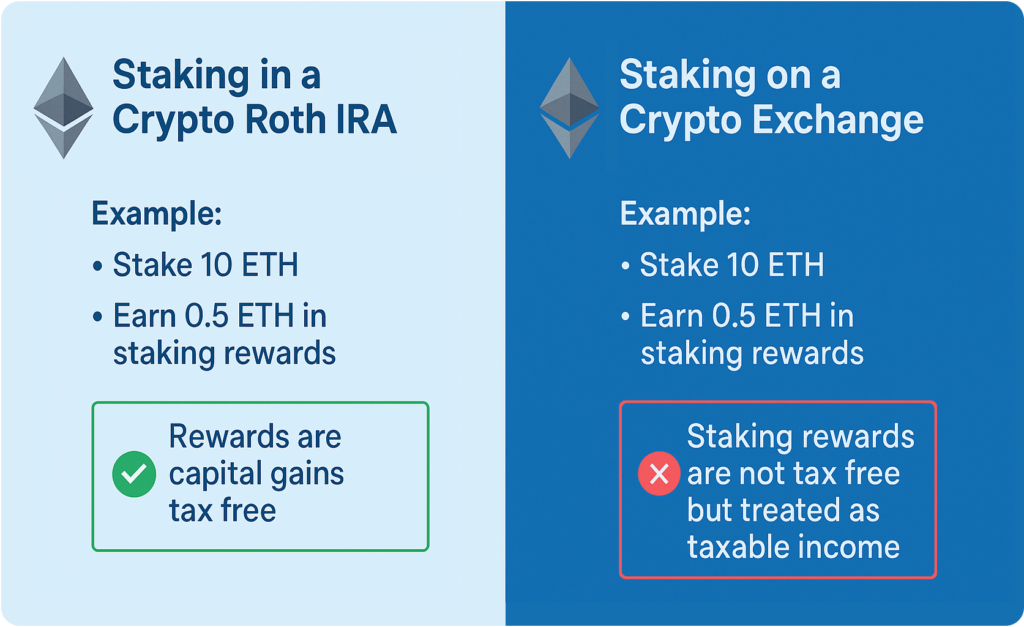
- Outside an IRA: Staking rewards are typically treated as ordinary income at fair market value when received — a tax event even if you don’t sell.
- Traditional Crypto IRA: Rewards accumulate tax-deferred. You don’t owe tax as rewards are earned; you’re taxed on withdrawals in retirement, same as any other Traditional IRA distribution.
- Roth Crypto IRA: Rewards can grow tax-free, and qualified withdrawals in retirement aren’t taxed at all — you’re staking with after-tax dollars up front in exchange for no tax on the growth.
One nuance worth flagging that the “set it and forget it, tax-free compounding” framing sometimes glosses over: iTrustCapital doesn’t auto-restake your rewards. To actually compound, you have to unstake, let rewards land in your account, and manually stake again — which means re-triggering that ~42-day ETH bonding period each cycle. Compounding is real, but it’s an active process, not a passive one.
As always, exact tax treatment depends on your specific IRA type, contribution history, and personal situation — this is a case where a five-minute call with a tax professional before you commit funds is genuinely worth it.
🎁 Limited-Time Bonus: Sign up using our exclusive iTrustCapital link and fund your account with $1,000 or more to claim a $100 funding bonus deposited directly into your new IRA!
Pros and Cons
Pros
- No need to run a validator or hold 32 ETH — stake with whatever ETH balance you have
- Tax-deferred or tax-free reward accrual, depending on IRA type
- No external wallet or private-key management
- Staking available across Traditional, Roth, and SEP IRA structures, plus non-IRA Premium Custody accounts
Cons
- ~42-day bonding period before ETH starts earning, plus up to 45 business days to get funds back after unstaking
- Meaningful fee taken off the top of gross rewards
- Rewards aren’t auto-compounded — manual unstake/restake required
- Staked ETH is locked and can’t be traded or sold until you unstake
- Standard crypto/staking risks apply: price volatility, slashing, and reliance on third-party infrastructure providers
How to Start Staking ETH with iTrustCapital
- Open a self-directed Crypto IRA (Traditional, Roth, or SEP) or a Premium Custody account with iTrustCapital.
- Fund the account via a new contribution, rollover, or transfer from an existing IRA/401(k).
- Buy ETH inside the account if you don’t already hold it there.
- Navigate to the staking section of your dashboard and select Ethereum.
- Review the current bonding period, fee, and reward-rate estimate shown on the confirmation screen — these can shift, so check them at the time you stake rather than relying on this article’s numbers.
- Confirm the deposit into staking. Your ETH enters the ~42-day bonding window before it starts earning.
- Monitor accrued rewards from your dashboard, and unstake when you want to access the ETH or rewards (allow up to 1-2 days unbonding, plus processing time).
Read More: How to Transfer 401k to iTrustCapital Without Penalty: A Step-by-Step Guide
FAQ: iTrustCapital Ethereum Staking Rewards
Does iTrustCapital actually offer Ethereum staking?
Yes — ETH staking is available inside Traditional, Roth, and SEP Crypto IRAs, as well as non-IRA Premium Custody accounts, alongside SOL staking.
How long until my ETH starts earning rewards?
Roughly 42 days of bonding, which is dictated by Ethereum network mechanics rather than by iTrustCapital.
Are staking rewards guaranteed?
No. Rewards are dynamic and depend on network conditions, validator performance, and participation rates, and can fluctuate over time.
Can I sell or trade my ETH while it’s staked?
No — staked ETH is locked. You have to unstake first, which triggers the unbonding and processing timeline above.
Are the rewards taxable inside my IRA?
Generally no tax is due as rewards accrue — Traditional IRA rewards are tax-deferred until distribution, and Roth IRA rewards can be tax-free on qualified withdrawal. Confirm your specific situation with a tax professional.
Are rewards automatically restaked/compounded?
No. You need to unstake, receive the reward, and stake again manually to compound.
Disclosure: This post may contain an affiliate link. iTrustCapital’s fees, bonding/unbonding timelines, and promotional offers are subject to change — verify current terms directly on iTrustCapital’s site before making a decision. This is not tax, legal, or investment advice. This article is for educational purposes only and isn’t tax, legal, or investment advice. Staking involves risk, including loss of principal, slashing, and illiquidity during lockup periods — talk to a licensed tax or financial professional before making decisions about your retirement account. iTrustCapital Staking Ethereum Rewards