
iTrustCapital Q Review: How It Works, Fees, Risks & My Experience
Can automated crypto strategies make investing inside a retirement account easier? I’m testing iTrustCapital Q with my own money. Here’s what I’m tracking, what investors should understand, and what I still need to learn before drawing conclusions.
Explore iTrustCapitalWhat Is iTrustCapital Q?
iTrustCapital Q is a collection of quantitative crypto trading strategies available through the iTrustCapital platform. Rather than requiring you to make every trading decision manually, the strategies use defined rules and market signals to determine trading activity.
Quantitative strategies can use factors such as price trends, momentum, volatility, and other market indicators. The exact strategy rules, supported assets, availability, and operating terms should be checked in the current iTrustCapital materials before you activate one.
One important distinction: algorithmic or quantitative trading is not the same thing as a system that can reliably predict the future. Market conditions change, signals can be wrong, and a strategy can lose money.
How Does iTrustCapital Q Work?
At a high level, a quantitative strategy follows a set of predefined rules. Those rules evaluate market information and may trigger trades based on the strategy's design.
Before using any automated strategy, read the current disclosures carefully. Understand which assets may be traded, how often trades may occur, what fees apply, and how to deactivate the strategy.
My iTrustCapital Q Test: Real Money, Real Tracking
I don't want to review an automated investing product based only on marketing material or hypothetical performance. I activated iTrustCapital Q with my own funds so I can follow what happens in a real account over time.
| Test detail | My setup |
|---|---|
| Initial investment | $1,000 |
| Strategy | Quantum Aggressive |
| Account type | Roth IRA |
| Activation date | November 22, 2026 |
| Testing status | Active — early stage |
| Verified performance | Not enough data yet |
I will update this section as I collect meaningful account data. The starting amount is not a profit figure, and no return is being claimed.
Track My iTrustCapital Q Performance
This is the interactive tracker I’ll use to document the test. You can also use it to follow your own Q account. Enter the latest account value and other figures from your account dashboard. The calculations update automatically.
My Q Performance Tracker
Update the figures whenever you want. Your entries are saved in this browser on this device.
Account value over time
30-, 60- and 90-day checkpoints
Saved performance history
| Date | Account value | Return | Notes |
|---|---|---|---|
| No saved updates yet. Save your first update to start your history. | |||
Important: this tracker stores data locally in your browser. It does not connect to iTrustCapital, retrieve live prices, or sync between devices. Export or record your information separately if you need a backup.
What Should I Measure During the Test?
A strategy's performance is more than whether the account balance is up on a particular day. I want to understand the activity behind the result, the costs involved, and how the strategy compares with a simpler alternative.
| Metric | Why it matters |
|---|---|
| Account value | Shows the current value of the account at each checkpoint. |
| Realized gains and losses | Helps distinguish completed trading results from changes in open positions. |
| Unrealized gains and losses | Shows how current holdings have changed in value. |
| Trading activity | Helps reveal how frequently the strategy trades and which assets are involved. |
| Fees and costs | Costs can reduce the amount of return an investor ultimately keeps. |
| Bitcoin comparison | Provides a simple benchmark, although Bitcoin alone is not a perfect comparison for a multi-asset strategy. |
iTrustCapital Q Fees: What Should You Check?
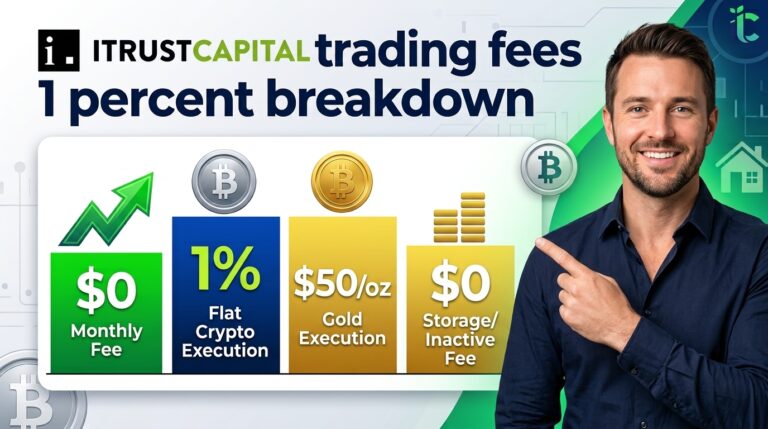
Fees are an important part of evaluating any automated trading strategy. Before activating or continuing with Q, review the current fee schedule and product disclosures directly through iTrustCapital.
In particular, look for:
- Any Q-specific strategy or management fee.
- Trading or transaction fees associated with strategy activity.
- Any spread or execution-related costs disclosed by the platform.
- Whether account-level fees apply to your specific IRA.
- Any costs or restrictions associated with changing or deactivating a strategy.
Potential Advantages of iTrustCapital Q
- Rules-based approach: Trading decisions can follow a defined process rather than depending entirely on emotional reactions.
- Less manual decision-making: Automated execution may reduce the need to monitor every market move yourself.
- Retirement account context: Eligible users may be able to use supported strategies within an iTrustCapital retirement account.
- Strategy choice: Different strategy options may offer different approaches to market exposure and risk.
- A structured way to test: Investors can monitor activity, costs, and results against a benchmark.
Potential Disadvantages and Risks
- Losses are possible: An algorithm cannot eliminate cryptocurrency market risk.
- Aggressive strategies can be volatile: A higher-risk strategy may experience significant declines.
- Past performance is not a promise: Backtests and historical simulations do not establish what future results will be.
- Trading costs matter: Frequent trading can make fees and execution costs especially important.
- Limited control: Investors should understand what decisions the strategy makes automatically and what choices remain theirs.
- Retirement account rules: IRA transactions, distributions, and tax treatment are subject to applicable rules.
Is Quantum Aggressive Right for Everyone?
No. I selected Quantum Aggressive for my own test, but that does not mean it is appropriate for every investor. A strategy with an aggressive risk profile may be unsuitable for someone who cannot tolerate substantial volatility or a potential loss of capital.
Before choosing a strategy, consider your investment timeline, risk tolerance, overall retirement allocation, and whether you understand how the strategy operates. Do not invest money you cannot afford to lose in a volatile asset class.
iTrustCapital Q in a Roth IRA: What to Understand
My own test is taking place in a Roth IRA. A Roth IRA is a tax-advantaged retirement account, but the account's tax treatment does not remove investment risk. The value of cryptocurrency holdings and strategy results can still rise or fall.
Roth IRA eligibility, contribution limits, distributions, and tax consequences depend on individual circumstances and current IRS rules. Automated trading inside a retirement account should not be confused with a guarantee of tax-free profits. Consult a qualified tax professional for advice about your situation.
How I’ll Judge the Results: 30, 60 and 90 Days
I plan to evaluate the strategy over multiple checkpoints rather than drawing conclusions from a few days of activity.
| Checkpoint | What I'll review | What it can tell me |
|---|---|---|
| 30 days | Trading activity, holdings, account value, fees, and early volatility. | An initial view of how the strategy behaves. |
| 60 days | Changes in performance, trading frequency, costs, and benchmark comparison. | Whether early observations are continuing or changing. |
| 90 days | Cumulative results, drawdowns, costs, and comparison with Bitcoin buy-and-hold. | A more useful early assessment, while still recognizing the short test period. |
Even 90 days is a relatively short period for evaluating a long-term retirement strategy. I will treat the results as observations from my test, not proof that the strategy will perform the same way in the future.
iTrustCapital Q vs. Buying and Holding Bitcoin
One of the comparisons I want to make is between the Q strategy and a simple buy-and-hold approach. The comparison can help show whether the additional strategy complexity has been worthwhile over the period measured.
| Factor | iTrustCapital Q | Bitcoin buy-and-hold |
|---|---|---|
| Approach | Uses a quantitative strategy and its defined trading rules. | Maintains exposure to Bitcoin without strategy-driven trading. |
| Trading activity | May trade based on strategy signals. | Typically involves fewer trades after the initial purchase. |
| Asset exposure | Depends on the selected strategy and current product rules. | Bitcoin exposure. |
| Costs to consider | Applicable strategy, trading, and platform costs. | Initial transaction costs and any applicable platform costs. |
| Risk | Market risk plus strategy and execution risks. | Bitcoin price volatility and custody/platform risks. |
This is not a perfectly like-for-like comparison if Q trades multiple cryptocurrencies or changes exposure over time. I will clearly identify the benchmark and the dates used when I publish actual results.
Who Might Consider iTrustCapital Q?
It may be worth researching if you already understand cryptocurrency volatility, want to explore rules-based strategies, and are comfortable reviewing the product's risks and costs.
It may be a poor fit if you expect guaranteed returns, need stable account values, do not understand the strategy, or would be uncomfortable with a significant decline.
Frequently Asked Questions
What is iTrustCapital Q?
iTrustCapital Q is a suite of quantitative crypto trading strategies available through the iTrustCapital platform. Review the current product information to understand the strategies, supported assets, and terms.
Is iTrustCapital Q AI-powered?
Do not assume that the live strategy continuously thinks or learns like a general-purpose AI assistant. Quantitative strategies generally operate using defined models, signals, and rules. Refer to iTrustCapital's current explanation for the specific role of AI in its product development and live operation.
Can iTrustCapital Q lose money?
Yes. Cryptocurrency prices can fall, and a quantitative strategy can make unsuccessful trades. Automated execution does not eliminate the possibility of losses.
Does iTrustCapital Q guarantee returns?
No investment strategy should be treated as a guaranteed source of returns. Historical, simulated, or backtested results are not a promise of future performance.
Can I use iTrustCapital Q in a Roth IRA?
My own test is activated in a Roth IRA. Availability can depend on the account and current product rules, so check the platform for your specific account before proceeding.
How much does iTrustCapital Q cost?
Review the latest official fee schedule and Q disclosures for any strategy-specific, trading, transaction, or account-related costs. Do not rely on outdated fee figures.
How long should I test iTrustCapital Q?
There is no single period that proves a strategy works. I am using 30-, 60-, and 90-day checkpoints to organize my observations, while recognizing that longer periods and different market conditions may be needed to evaluate a strategy.
Can I deactivate a Q strategy?
Check the current iTrustCapital instructions and terms for the exact process, timing, and any applicable costs or restrictions before activating a strategy.
Want to Explore iTrustCapital?
Review the platform, account options, supported assets, and current terms before deciding whether it fits your retirement investing goals.
Visit iTrustCapitalThe link above is an affiliate link. I may earn a commission if you sign up through it, at no additional cost to you.
My iTrustCapital Q Review: What Happens Next?
My Quantum Aggressive test is still in its early stages. I started with $1,000 in a Roth IRA on November 22, 2026. I do not have enough real-world data yet to say whether the strategy is outperforming Bitcoin, whether its trading activity justifies the costs, or whether the results will be consistent.
As the test develops, I intend to update this review with account observations, performance figures, trading activity, costs, and benchmark comparisons. I would rather publish honest results—including disappointing ones—than make claims based on incomplete information.
Financial disclaimer: This content is for informational and educational purposes only and is not financial, investment, tax, or legal advice. Cryptocurrency and automated trading strategies involve risk, including the possible loss of principal. Past performance and backtested results do not guarantee future results. Always review the provider's current terms, fees, and disclosures and consider consulting a qualified professional before making investment decisions.